


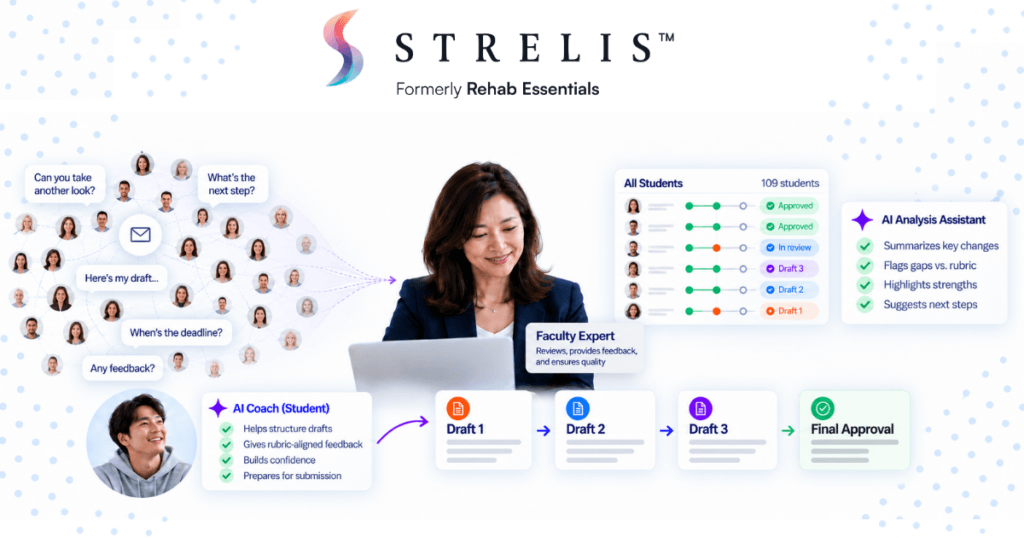
A human-led, AI-enhanced redesign strengthened student support, preserved academic quality, and reduced direct advising and review costs by 83%.
In Summer 2026, Strelis and its university partner redesigned the capstone process to address a familiar challenge in health professions education: how to provide responsive, individualized support at scale without increasing faculty workload or compromising academic oversight.
The pilot replaced a fragmented, advisor-led process with a centralized, transparent workflow supported by responsible AI. The result was a better experience for students, greater visibility for program leadership, and significantly stronger program economics.
For a closer look at the redesigned workflow, measured results, and implications for health professions programs, read the full case study.
The challenge
The capstone course historically relied on more than 80 individual capstone advisors. After receiving proposal approval, each student was manually matched with an advisor before beginning the writing phase.
Although the model generally produced good academic outcomes, it created several challenges:
- Students could wait a week or more to be matched with an advisor.
- Draft feedback and answers to questions could take several additional days.
- Advising occurred primarily through email, outside the learning management system.
- Feedback, pacing, and readiness standards could vary by advisor.
- Program leaders had limited visibility into student progress and communication.
- The distributed model required considerable coordination and expense.
The term “capstone” also created anxiety for some prospective international students, who sometimes interpreted it as a dissertation-like requirement and questioned whether they could successfully complete the program.
The solution
The team redesigned the workflow—not simply by adding AI, but by reconsidering how students, faculty, technology, and the LMS could work together.
One centralized Capstone Reviewer guided all students through three cumulative drafts in the learning management system. A purpose-built AI Agent, grounded in the course requirements, curriculum, and grading criteria, helped the reviewer analyze drafts and prepare feedback.
Human judgment remained central. The reviewer validated and personalized all AI-supported feedback and determined when students were ready to progress. The Capstone Coordinator continued to approve proposals, oversee the course, manage escalations, and independently evaluate final submissions.
Students also gained access to an AI Capstone Coach that provided immediate, requirements-based support between formal reviews. Students could ask questions, check drafts against expectations, and identify areas for revision without waiting for an emailed response. The Coach supported students’ work; it did not write the project for them.
Moving the entire process into the learning management system gave the program clear visibility into every student’s progress, feedback, approvals, and completed milestones.
The results
-
- 109 students passed the Summer 2026 course
- 0 students who entered the writing phase failed
- No substantive issues were identified in final submissions
- Direct reviewer expense declined from a historical semester average of $32,293 to $5,450
- Estimated savings: $26,843, or approximately 83%
Final projects were consistently polished and met capstone requirements. The structured workflow also eliminated approval gaps: students could not bypass required drafts or disappear from the process until the end of the semester.
Students continued to report feeling supported and described the experience as contributing to their academic confidence and professional growth.
Modernization temporarily creates two workloads
Institutions frequently pair growth with modernization: a program may introduce hybrid delivery, redesign a curriculum, adopt new learning technology, or create a more flexible experience for working learners. The long-term model may be more efficient. The transition is not.
During implementation, faculty and leaders must operate the current program while building the next one, making decisions about curriculum, instructional design, technology, faculty development, and accreditation while continuing to deliver existing courses. This transition work is routinely underestimated because it does not appear clearly in ongoing staffing plans. It shows up as committee work, course revision, and delayed priorities, and when no explicit time or resources are set aside for it, the work is absorbed by the people already responsible for maintaining quality.
Modernization plans should therefore distinguish between:
- Ongoing capacity: What the future program will require once implemented
- Implementation capacity: What the institution needs to design, validate, launch, and stabilize the new model
Without dedicated implementation capacity, the initiative reduces the capacity available to operate the current program.
As enrollment grows across cohorts, sections, locations, or modalities, variation becomes more likely. Faculty may interpret course expectations differently. Assessments may drift from intended outcomes. Content updates may occur unevenly. Student support needs may surface later because the signals are distributed across a larger population.
The result is a different form of capacity pressure. Faculty are not simply teaching more students. They are managing more handoffs, more exceptions, and more opportunities for inconsistency.
This is why course design must be able to support growth. Clear alignment to outcomes, dependable course materials, a shared approach to assessment, defined areas for faculty discretion, and content that can be maintained over time reduce preventable variation without removing faculty judgment from the learning experience.
The distinction is important: academic scale should standardize what protects quality while preserving the faculty judgment that creates value.
A stronger student experience—and a more sustainable program model
The pilot demonstrates what responsible program modernization can accomplish when academic and operational improvement are considered together.
Students received faster, more consistent support. Faculty expertise remained focused on feedback, judgment, and mentorship. Program leaders gained greater oversight and confidence in academic quality. The university significantly reduced direct advising expense, strengthening the program’s financial model.
The redesign also gives prospective students a clearer, more reassuring understanding of the culminating project: it is a structured, manageable process with defined milestones, immediate resources, and ongoing human support. This can help remove a concern that may otherwise discourage qualified international students from enrolling.
The next step is to pilot a single capstone course with distinct project pathways while continuing to measure workload, quality, cost, and student perception.
This is the Strelis CompleteTM partnership in action: continuously improving the academic and operational experience to better support students, strengthen university economics, and build programs positioned for sustainable enrollment growth.
